Why reading streaks work, and when they stop working
The BookWyse Team · 8 September 2026 · 7 min read
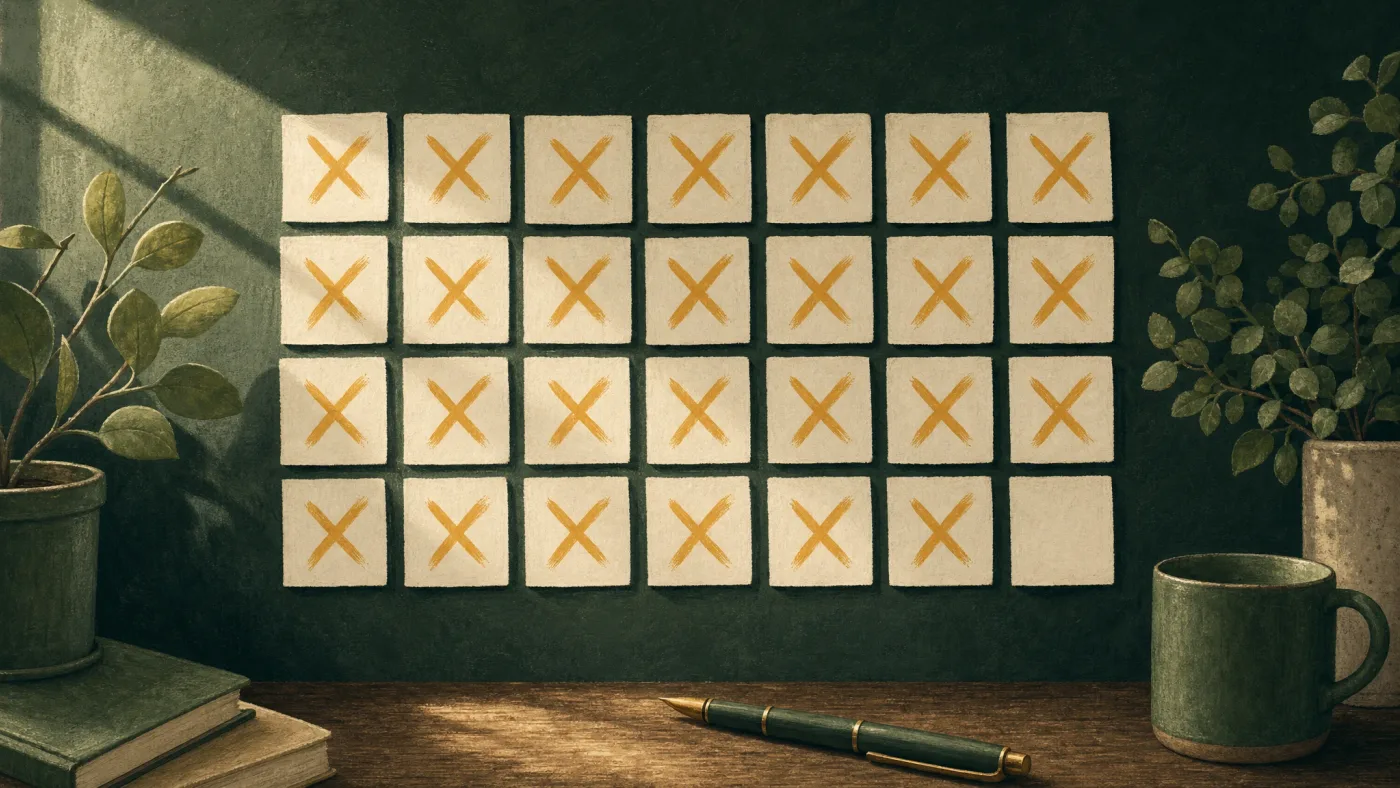
Jerry Seinfeld may or may not have given the advice everyone attributes to him. The story goes that a young comedian asked him how to get better, and he said: get a wall calendar, write a joke every day, and put a red X on each day you do. After a while you have a chain. Your only job is not to break the chain.
Whether or not he ever said it, the method is real, and it survives because it does something clever. It replaces a goal you cannot see with a thing you can.
The goal is invisible; the chain is not
"Become a reader" is not a target you can aim at. There is no moment where it happens, no threshold you cross, no day you wake up qualified. The same is true of most things worth doing, which is why they are hard to sustain — the feedback arrives years after the effort.
A chain of days is the opposite. It is immediate, unambiguous, and visible. You either read yesterday or you did not, and the record either extends or it does not. That is a very small satisfaction, but it arrives every single day, which is exactly when you need something to arrive.
None of this makes you a better reader on day three. What it does is keep you present until the real rewards — the ones that come from having read a lot, over years — have time to show up.
Loss aversion is doing most of the work
The reason a streak grips harder than a goal is not motivation. It is that a streak converts reading into something you can lose.
People are reliably more moved by losing something they hold than by gaining something equivalent. It is one of the more robust findings in behavioural economics, and it is not flattering, but it is useful. A goal of "read more" offers you a gain, and gains are easy to defer to tomorrow. An eighteen-day streak offers you a loss, and losses are much harder to shrug at.
This is why the difficulty curve inverts. Day three is easy to break and nobody minds. Day forty is very hard to break, because forty days of accumulated evidence is now a thing you own.
It also explains the specific, slightly absurd feeling of reading two pages at 11:52pm. That is loss aversion, working exactly as designed. Whether that is a good thing depends entirely on what your streak is set up to count.
The identity shift is the real prize
There is a better reason to keep a chain going, and it takes a couple of weeks to arrive.
Somewhere around day ten to fourteen, the story you tell yourself changes. You stop being a person who is trying to read more and become a person who reads. It is a small shift and it sounds like semantics, but it changes how decisions get made. Someone trying to read more has to win an argument with themselves every evening. Someone who reads does not have the argument.
The streak is what carries you across that gap. It supplies an external reason to show up during the fortnight before the internal reason exists.
After that it matters much less. Long-term readers rarely track anything. They do not need to — the behaviour has stopped requiring support. If your streak eventually becomes uninteresting to you, that is not the system failing. That is it finishing its job.
What a streak must count
For any of this to work, the daily requirement has to be small enough to be genuinely unbreakable.
If your streak requires thirty minutes, you will break it, because some days do not contain a spare thirty minutes and no amount of resolve creates them. And the first break is not the real damage. The real damage is what people do afterwards: having lost twenty-two days, they conclude the whole thing was a fiction and stop entirely. The chain was carrying more weight than it could hold.
So set the bar at something absurd. A page. Two pages. Five minutes. On a good night you will read far more, and the streak simply records that you showed up. On a terrible night the streak is still achievable while you are half asleep, and it survives.
A streak measuring "did I read at all" is durable for years. A streak measuring "did I read properly" breaks within a month and takes the habit with it.
When to ignore it
There are three moments when the number is actively working against you, and you should be able to recognise all three.
When you are reading to protect the count. If you notice you have read the same paragraph three times and taken in none of it, you are not reading, you are servicing a metric. Close the book. Take the broken day. The chain exists to get you reading; when it becomes the reason you cannot read, it has inverted.
When it is making you choose worse books. Watch for the moment you avoid a dense, slow book because it threatens your daily page count. That is the tail wagging the dog. The best books are frequently the slowest, and a system that steers you away from them is a bad system regardless of how good the number looks.
When a broken streak becomes a verdict. Everyone breaks eventually — illness, travel, a genuinely brutal week. The number resets to zero and there is a real, disproportionate sting to it. But the reading you did during those forty days did not reset. You still read those pages, still finished those books, still are the person the streak helped you become. Only the counter went back to zero.
If a reset makes you stop reading for a fortnight, the streak has become the point, and the point was never the streak.
The two-day rule is better than a perfect record
If you want one rule that outperforms an unbroken chain, it is this: never miss twice.
Missing one day is statistically meaningless. Habit researchers who have actually measured this find that a single lapse has essentially no effect on whether a behaviour eventually becomes automatic. What matters is the second consecutive miss, and then the third, because that is the point where the absence starts to feel normal and the anchor loses its grip.
So treat a single missed day as a non-event. Do not make it up. Do not read forty pages on Tuesday to compensate for Monday, which just teaches you that reading is a debt. Read your two pages on Tuesday and carry on.
The practical version, if you travel or your weeks are genuinely unpredictable: decide your rule in advance, while you are calm. Something like I read every day, and if a day is impossible I read the next one no matter what. Deciding it in advance matters, because the alternative is deciding it at 11pm on the day you failed, when you are tired and inclined to write the whole thing off.
Some people keep a small allowance — a couple of skip days a month, used deliberately rather than accidentally. That sounds like cheating and it is not. A planned gap does not damage a habit. An unplanned one that turns into a week does.
Restarting is the skill
The genuinely useful habit is not maintaining a chain. It is starting a new one the next day without ceremony.
Almost everybody can build a streak. Very few people can lose a good one and simply begin again on Tuesday without treating it as evidence about their character. That second skill is worth more than the first, because over a reading life you will restart many more times than you will build.
Read a page today. If the counter says one, that is fine. It said one before the forty as well.