How to track your reading without turning it into admin
The BookWyse Team · 8 September 2026 · 6 min read
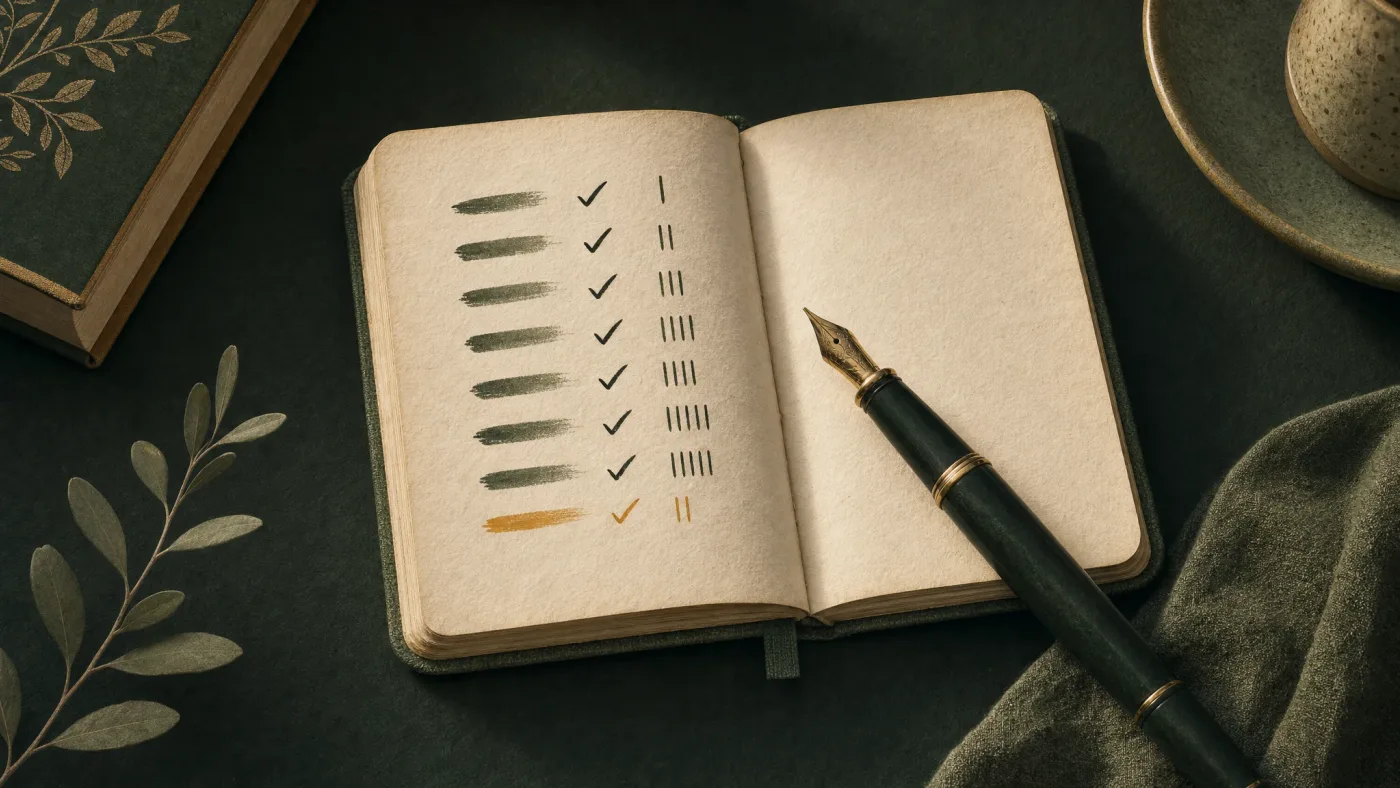
There is a specific kind of reader who ends up spending more time maintaining their reading system than reading. Ratings on five axes, spreadsheets with a column for page count and one for genre and one for source, an annual target broken down by month.
There is another kind who tracks nothing, has no idea what they read last year, and cannot remember the name of the book that changed their mind about something important.
Both are losing something. The useful position is narrower than either, and it takes about fifteen seconds a day.
What tracking is actually for
Two things, and it is worth being clear about them because everything else is decoration.
It closes the feedback loop. Reading produces almost no signal on any given day. You read twenty pages and nothing happens — no score, no completion, nothing that says the evening counted. Over weeks, a behaviour with no feedback loses to behaviours with immediate ones, which is most of what a phone contains. Logging a day is a small deliberate signal in an activity that otherwise supplies none.
It gives you a record you cannot reconstruct. You will not remember what you read in 2024. You certainly will not remember what you thought of it. That information is only available if you captured it at the time, and it costs almost nothing to capture and is impossible to recover later.
Anything your tracking does beyond those two things is a hobby. Which is fine — but recognise it as a separate hobby, and do not let it bill its time to reading.
Track days, not books
If you only record one thing, record whether you read today. Not how much, not what.
Days work because they resolve daily. Books resolve every two or three weeks, which is far too slow to reinforce a daily habit — you can read well for eleven consecutive days and have nothing to show for it, which is precisely the pattern that makes habits collapse.
Pages or minutes are a reasonable middle ground and are worth logging if you want a sense of pace. But the primary unit should be the day, because the day is the thing you are actually trying to make happen.
An annual book target is the worst of the three. A number like "fifty-two books" says nothing about today, arrives too late to correct, and creates a bias toward shorter books that has nothing to do with reading well.
Three questions worth writing down when you finish
This is the part almost nobody does and the part that pays off for years.
When you finish a book, before you shelve it, write three short answers:
- What was it actually about? One sentence. Not the blurb — what it was doing.
- What will I still remember in a year? Usually one image, one argument, or one scene.
- Who should read this, and why?
Ninety seconds, total. Then put it wherever you keep such things and forget about it.
The third question is the sleeper. It forces you to articulate what kind of person the book is for, which is a much sharper judgement than whether you liked it, and it means that in two years when a friend describes a problem, you will actually be able to hand them the right book instead of vaguely remembering that you read something relevant once.
Ratings are less useful than they look
A five-star rating compresses everything into one number, and the compression throws away the part you needed.
Three stars can mean a competent book on a subject you did not care about, or a flawed book with two extraordinary chapters, or a book you would have loved at a different point in your life. In a year you will see "3" and have no idea which. The number is a summary of a feeling you no longer have access to.
If you like rating things, keep it — it costs nothing and it makes lists easier to sort. Just do not let it substitute for the sentence. A rating with one line of context is genuinely useful. A rating alone is a number you will not trust in eighteen months.
Where the tracking starts to hurt
There is a real failure mode, and it has recognisable symptoms.
You choose shorter books to keep a count moving. The metric is now selecting your reading, which is the wrong way round.
You avoid rereading because it "doesn't count". Rereading is one of the most valuable things a reader does, and any system that discourages it is broken.
You skim the last thirty pages to log a finish. At this point you are producing data rather than reading.
Logging feels like a task. If the act of recording takes long enough to be a decision, it will eventually be the thing you skip, and it will take the habit with it.
The general test: does the number ever make you read something you would not otherwise have chosen, or avoid something you would? If yes, stop tracking that number for a month and see whether your reading improves. Usually it does.
Reading goals, if you must have one
If you want an annual target, set it on days rather than books. "Read on 300 days this year" is a goal you can act on this evening and cannot game by choosing thin books.
And set it low enough that you would be embarrassed to miss it. A target you hit in March is far more useful than one you abandon in February, because the entire function of a target is to keep you going, not to be impressive.
Paper or app, and it matters less than you think
People spend a surprising amount of energy on this choice. Both work. What matters is which one you will still be using in November.
A notebook is unbeatable for the three-line summary. Writing by hand is slower, which is the point — the extra seconds are thinking time, and handwritten notes tend to be better notes. It also cannot notify you, show you what anyone else is reading, or turn into ten minutes of browsing.
An app is unbeatable for the daily log, because the log has to be effortless or it will not happen. One tap, from the device already in your hand, at the moment you stop reading. An app is also the only option that can hold your highlights next to the book, and the only one you can search in four years.
The hybrid most long-term readers land on is exactly that split: tap the day in whatever you read in, write the summary by hand. Neither tool is asked to do the thing it is bad at.
What definitely does not work is three systems. Highlights in one app, a list in another, notes in a third, and no single place that knows what you have read. That is how a record becomes unusable — not through neglect, but through scatter.
The version that fits in fifteen seconds
If you want the whole system in one paragraph: log the day, in one tap. Write three lines when you finish something. Look at the record twice a year — once around the middle, once at the end — and notice what you actually read rather than what you meant to.
That is it. Anything more elaborate should have to justify itself against the only thing that matters, which is whether you opened a book tonight.